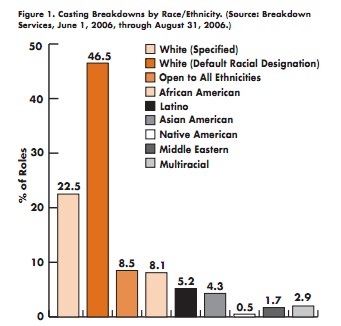
By now many of you have probably read the novel The Hunger Games. If you haven't, here's a quick synopsis. There has been a huge uproar in the fandom about the characters Cinna and Rue, who many pictured to be white. I'm willing to admit that I can count myself into those who imagined these characters as white. But let's take a look at how they are described in the books.

Cinna:

Rue:
And to end this confusion all together, a little bit from an interview with the author of The Hunger Games, Suzanne Collins:

Cinna:
"I'm taken aback by how normal he looks...But Cinna's close-cropped hair appears to be its natural shade of brown. He's in a simple black shirt and pants. The only concession to self-alteration seems to be metallic gold eyeliner that has been applied with a light hand. It brings out the flecks of gold in his green eyes" (Collins 63).And yet people are AGHAST that Lenny Kravitz is cast as Cinna. The only contradictory detail I could find in the trailer vs the book's description was the color of his eyes, which are hard to tell exactly but look very much like they are brown.

Rue:
"...a twelve-year-old girl from District 11. She has dark brown skin and eyes, but other than that, she's very like Prim in size and demeanor" (Collins 45).And again, Rue, since she is constantly described by Katniss as being very much like Prim, was assumed to be young, white, and blonde, though it is clearly stated in the book that she has "dark brown skin."
And to end this confusion all together, a little bit from an interview with the author of The Hunger Games, Suzanne Collins:
Some readers have expressed real frustration that white actors were cast in the roles of Katniss and Gale, who they felt were clearly described as biracial in the book. Do you understand or share any of that dismay Suzanne?Why is it that many people assume neutral gender as being white? Even I, as a bi-racial person, assumed that both of these characters were white, even though it was contradicted in the text of the novel. I'd like to explore more on this subject, which I will do in future blog posts. I'd also like to hear your thoughts on this issue. How do you feel about these casting decisions? If you've read The Hunger Games, is this how you imagined Rue and Cinna? What are your thoughts on white being a "neutral race?" Leave any insight you have in the comments below, I'd love to hear what you have to say!
SC: They were not particularly intended to be biracial. It is a time period where hundreds of years have passed from now. There’s been a lot of ethnic mixing. But I think I describe them as having dark hair, grey eyes, and sort of olive skin. You know, we have hair and makeup. But then there are some characters in the book who are more specifically described.
GR: Thresh and Rue.
SC: They’re African-American.
So will those roles go to black actors?
GR: Thresh and Rue will be African-American. It’s a multi-racial culture and the film will reflect that. But I think Suzanne didn’t see a particular ethnicity to Gale and Katniss when she wrote it, and that’s something we’ve talked about a lot.