Today I'd like to talk a little bit about color-blind casting in both Broadway plays and Hollywood movies. This is an issue for both nonwhite actors and those who study and percieve racial inequalities in the United States (I'm going to stick to just the US, because there are other racial issues when moving to other countries). To begin to address this issue, the root starts at the scripts for movies and plays. This chart shows the breakdown of casting calls between June 1-August 31, 2006 for roles (not extras or stunt people):


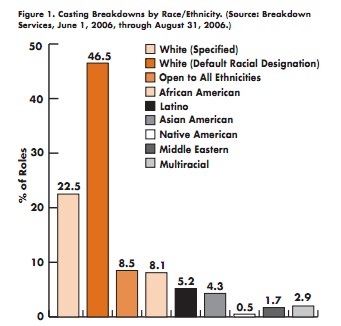
Not only do the vast majority of specified roles go to white people, but almost half of all of the roles are unspecified roles that by default go to white people.
It's pretty easy to see the inequality here, but let's play a little devil's advocate and move to the other side of the issue. There are movies and plays that REQUIRE specific genders to increase the plot's meaning. Take a play/movie like Hairspray, for example. The plot hinges upon there being black and white characters. If Penny and Seaweed weren't a black man and white woman, would the song "Without Love" make any sense at all?
Let's look at some recent examples of mixed-race casting. One movie that recently came under fire was M. Night Shyamalan's The Last Airbender. This movie is based on the children's show Avatar: The Last Airbender, an animated show in which all of the main characters were Asian.

But in the live action movie version, most of the actors playing these characters were white.

Shyamalan's response? He actually WAS practicing color blind casting: he chose which actors he thought best for the main roles, regardless of their race. He claimed that the anime style of the original series left the race of the main characters open for interpretation, and he took the artistic interpretation he was allowed as director.
And sometimes, white actors are chosen to play non-white characters. Angelina Jolie, who usually looks like this:
 Played Marlane Pearl, a French reporter with Afro-Cuban and Dutch heritage in the film A Mighty Heart. Jolie's skin and hair were darkened for the role, so that she more resembled Pearl.
 But Jolie was selected by Pearl herself, believing that Jolie would provide the most integrity to the role.
So my question to you, readers, is:
Should color-blind casting always be practiced? Sometimes? Never? When is it appropriate?
Feel free to leave your thoughts on color-blind casting vs traditional, race-specified casting in the comments.
As always, thanks for reading!!
Meghana


So my question to you, readers, is:
Should color-blind casting always be practiced? Sometimes? Never? When is it appropriate?
Feel free to leave your thoughts on color-blind casting vs traditional, race-specified casting in the comments.
As always, thanks for reading!!
Meghana

