Pages

Search This Blog

Showing posts with label race. Show all posts

Tuesday, April 17, 2012

Implicit Racism

I don't mean to be racist, but...

I hear this more often than I'd like. And I also get "but you're not black..." when I express distaste at an inappropriate racist joke or statement said around me. I think this is extra pronounced in the predominately white and Jewish suburb of Chicago I come from, but I also think that implicit racism is a huge problem ingrained in the culture of America.

It isn't accepted or allowed in 2012 to be openly racist, but tell a racist joke in my high school and you'll always get a chuckle. But for the few people of color (myself included) in my school, race is a daily reminder of how we're different. I often get jokes about Bindis, convenience stores, or the fact that my dad's name is Guru. Not that I think anyone's trying to be rude or to be racist, but there are often jokes that are a little too close for comfort.

Especially now, in the wake of the murder of Trayvon Martin, implicit racism is a huge problem in our society. I think that much of the problem is that much of the racism in this country comes more from a place of ignorance than of actual hate. People have been bred for so long not to notice this type of racism that it takes people of color to point it out over and over and over until someone finally takes notice.

How do we change people's views though? How do we educate people to realize that race should not be an issue for us in 2012? And what can I, as a simple high school student, do about it? This is a question I struggle with daily, and one that I do not have the answer to. If any of you readers have any idea on what to do, I'd be glad to hear it, because I'm stumped.

Wednesday, April 4, 2012

Are you racist?

Here's a test to find out!

It will also tell you if you're prejudiced against different religions, sexes, sexualities, weights, ages, presidents, and more!

But are these results valid? I, a huge advocate for equality in every sense of the world, showed up with a slight preference for light skin and a slight preference for straight people. But is this true? Honestly, I don't think it shows a lot about me, but I think that this test can illuminate something you may not have realized in yourself. The test measures the time it takes you to sort words into categories. For example, you sort the skin tones into two categories, but they can be matched with good and bad as well. But I think that like myself, many people would not say that they have a preference to a skin tone but may get a different result when taking the test. So as readers, I'd like to ask you something. Post in the comments if you take the test, and if you think it aligns with what you consider yourself to be.

Look out for my next post soon, I'd like to talk about implicit racism in our society, and maybe this test can help you realize some implicit racism that you carry with you before you read my next post.

Tuesday, December 13, 2011

BLACK PEOPLE IN THE HUNGER GAMES?!

By now many of you have probably read the novel The Hunger Games. If you haven't, here's a quick synopsis. There has been a huge uproar in the fandom about the characters Cinna and Rue, who many pictured to be white. I'm willing to admit that I can count myself into those who imagined these characters as white. But let's take a look at how they are described in the books.


Cinna:
"I'm taken aback by how normal he looks...But Cinna's close-cropped hair appears to be its natural shade of brown. He's in a simple black shirt and pants. The only concession to self-alteration seems to be metallic gold eyeliner that has been applied with a light hand. It brings out the flecks of gold in his green eyes" (Collins 63).
And yet people are AGHAST that Lenny Kravitz is cast as Cinna. The only contradictory detail I could find in the trailer vs the book's description was the color of his eyes, which are hard to tell exactly but look very much like they are brown.


Rue:
"...a twelve-year-old girl from District 11. She has dark brown skin and eyes, but other than that, she's very like Prim in size and demeanor" (Collins 45).
And again, Rue, since she is constantly described by Katniss as being very much like Prim, was assumed to be young, white, and blonde, though it is clearly stated in the book that she has "dark brown skin."

And to end this confusion all together, a little bit from an interview with the author of The Hunger Games, Suzanne Collins:

Some readers have expressed real frustration that white actors were cast in the roles of Katniss and Gale, who they felt were clearly described as biracial in the book. Do you understand or share any of that dismay Suzanne?
SC: They were not particularly intended to be biracial. It is a time period where hundreds of years have passed from now. There’s been a lot of ethnic mixing. But I think I describe them as having dark hair, grey eyes, and sort of olive skin. You know, we have hair and makeup. But then there are some characters in the book who are more specifically described.
GR: Thresh and Rue.
SC: They’re African-American.
So will those roles go to black actors?
GR: Thresh and Rue will be African-American. It’s a multi-racial culture and the film will reflect that. But I think Suzanne didn’t see a particular ethnicity to Gale and Katniss when she wrote it, and that’s something we’ve talked about a lot.
Why is it that many people assume neutral gender as being white? Even I, as a bi-racial person, assumed that both of these characters were white, even though it was contradicted in the text of the novel. I'd like to explore more on this subject, which I will do in future blog posts. I'd also like to hear your thoughts on this issue. How do you feel about these casting decisions? If you've read The Hunger Games, is this how you imagined Rue and Cinna? What are your thoughts on white being a "neutral race?" Leave any insight you have in the comments below, I'd love to hear what you have to say!

Saturday, November 12, 2011

Color-Blind Casting

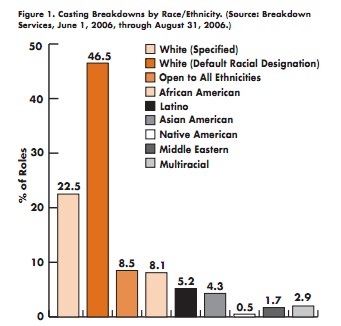
Today I'd like to talk a little bit about color-blind casting in both Broadway plays and Hollywood movies. This is an issue for both nonwhite actors and those who study and percieve racial inequalities in the United States (I'm going to stick to just the US, because there are other racial issues when moving to other countries). To begin to address this issue, the root starts at the scripts for movies and plays. This chart shows the breakdown of casting calls between June 1-August 31, 2006 for roles (not extras or stunt people):

Not only do the vast majority of specified roles go to white people, but almost half of all of the roles are unspecified roles that by default go to white people.

It's pretty easy to see the inequality here, but let's play a little devil's advocate and move to the other side of the issue. There are movies and plays that REQUIRE specific genders to increase the plot's meaning. Take a play/movie like Hairspray, for example. The plot hinges upon there being black and white characters. If Penny and Seaweed weren't a black man and white woman, would the song "Without Love" make any sense at all?

Let's look at some recent examples of mixed-race casting. One movie that recently came under fire was M. Night Shyamalan's The Last Airbender. This movie is based on the children's show Avatar: The Last Airbender, an animated show in which all of the main characters were Asian.

But in the live action movie version, most of the actors playing these characters were white. 

Shyamalan's response? He actually WAS practicing color blind casting: he chose which actors he thought best for the main roles, regardless of their race. He claimed that the anime style of the original series left the race of the main characters open for interpretation, and he took the artistic interpretation he was allowed as director. 

And sometimes, white actors are chosen to play non-white characters. Angelina Jolie, who usually looks like this:
Played Marlane Pearl, a French reporter with Afro-Cuban and Dutch heritage in the film A Mighty Heart. Jolie's skin and hair were darkened for the role, so that she more resembled Pearl.
But Jolie was selected by Pearl herself, believing that Jolie would provide the most integrity to the role.

So my question to you, readers, is:
Should color-blind casting always be practiced? Sometimes? Never? When is it appropriate?
Feel free to leave your thoughts on color-blind casting vs traditional, race-specified casting in the comments.

As always, thanks for reading!!
Meghana

Sunday, October 9, 2011

Racism: Discrimination Based on Aesthetic Differences

One thing that interests me most about aesthetics is the human perception of aesthetic differences. What got me thinking about this is the book we are currently reading in my English class, The Poisonwood Bible by Barbra Kingsolver (if you need a quick summary, here is one). I find it interesting to hear the reactions of this white family from the South to native African culture and the differences they find between them and the Congolese.

It is funny to me to look back at the many justifications for racism, when in reality, it all comes down to discrimination based on aesthetic differences. It is interesting to note that racism is a fairly modern concept. Before there were people objecting to the morality of slavery, there was really no rationale for slavery other than its convenience. There began to be modern racism when people started to realize that slavery was a massive human rights abuse. It was then that they had to form some sort of rationale as to why slavery existed, and that was that people of color were inferior to whites.

There were many ideas of why blacks specifically were inferior to whites. In the book, the girls don't really understand why, other than that is what they always have known. The youngest girl, Ruth May, is interesting because she is used to talk about sensitive subjects since she is just a child regurgitating what she hears. She says that it's not the Congolese people's fault that they are doomed to this life without God's light, because they are the tribes of Ham and are doomed to be in servitude forever. This was a prominent rationale among white Southerners defending slavery. Using the Bible as evidence for the inherent inferiority of blacks was an easy way to say that whites were meant to be superior.

There were attempts to say that blacks were genetically inferior, that they were the middle ground between Caucasians and apes. There have even been attempts to show that based on different body measurements, blacks did not grow past puberty, and therefore it was the whites' job to take care of them.

All of these attempts at justification come back to the one issue, that a certain group of people were discriminated against based on something they can not control: the color of their skin. This shows how important aesthetics really are, by just looking a certain way it can affect your place in society. In further blogs, I'd like to explore a little bit more about the different types of aesthetic differences that can affect how you are percieved.

Until next time,
Meghana