Pages

Search This Blog

Tuesday, December 13, 2011

BLACK PEOPLE IN THE HUNGER GAMES?!

By now many of you have probably read the novel The Hunger Games. If you haven't, here's a quick synopsis. There has been a huge uproar in the fandom about the characters Cinna and Rue, who many pictured to be white. I'm willing to admit that I can count myself into those who imagined these characters as white. But let's take a look at how they are described in the books.


Cinna:
"I'm taken aback by how normal he looks...But Cinna's close-cropped hair appears to be its natural shade of brown. He's in a simple black shirt and pants. The only concession to self-alteration seems to be metallic gold eyeliner that has been applied with a light hand. It brings out the flecks of gold in his green eyes" (Collins 63).
And yet people are AGHAST that Lenny Kravitz is cast as Cinna. The only contradictory detail I could find in the trailer vs the book's description was the color of his eyes, which are hard to tell exactly but look very much like they are brown.


Rue:
"...a twelve-year-old girl from District 11. She has dark brown skin and eyes, but other than that, she's very like Prim in size and demeanor" (Collins 45).
And again, Rue, since she is constantly described by Katniss as being very much like Prim, was assumed to be young, white, and blonde, though it is clearly stated in the book that she has "dark brown skin."

And to end this confusion all together, a little bit from an interview with the author of The Hunger Games, Suzanne Collins:

Some readers have expressed real frustration that white actors were cast in the roles of Katniss and Gale, who they felt were clearly described as biracial in the book. Do you understand or share any of that dismay Suzanne?
SC: They were not particularly intended to be biracial. It is a time period where hundreds of years have passed from now. There’s been a lot of ethnic mixing. But I think I describe them as having dark hair, grey eyes, and sort of olive skin. You know, we have hair and makeup. But then there are some characters in the book who are more specifically described.
GR: Thresh and Rue.
SC: They’re African-American.
So will those roles go to black actors?
GR: Thresh and Rue will be African-American. It’s a multi-racial culture and the film will reflect that. But I think Suzanne didn’t see a particular ethnicity to Gale and Katniss when she wrote it, and that’s something we’ve talked about a lot.
Why is it that many people assume neutral gender as being white? Even I, as a bi-racial person, assumed that both of these characters were white, even though it was contradicted in the text of the novel. I'd like to explore more on this subject, which I will do in future blog posts. I'd also like to hear your thoughts on this issue. How do you feel about these casting decisions? If you've read The Hunger Games, is this how you imagined Rue and Cinna? What are your thoughts on white being a "neutral race?" Leave any insight you have in the comments below, I'd love to hear what you have to say!

Thursday, December 8, 2011

Fashion in Politics

Appearance is a huge part of politics. Voters will not elect or support someone that does not look a certain way, and especially for women this is a huge issue. A male politician has a neutral dress option: dark suit, white shirt, tie. What does a female politician have? Nothing of the sort. Women are constantly being judged based on what clothes they are wearing, not what new revolutionary or intellectual ideas that they have. Voters want someone that looks put together, that looks appropriate, and does not dress too "out there." Take Condollezza Rice for example, she wore a dark coat and heeled boots, and much of the American public was uncomfortable with her dressing "too sexy." This is an issue for female politicians in America. They are constantly judged based on what they wear.

Michelle Obama has worked hard on a national campaign to fight child obesity while serving as First Lady, but when she steps out most of the headlines about her are related to what she chose to wear. This is unfortunate for her because it shifts the focus of whatever she does to her attire, and if it is not deemed appropriate then it doesn't matter what she originally set out to do, because all eyes are on the clothes. To give Mrs. Obama quite a bit of credit, though, I think that she has done wonderful things to choose her clothing very wisely. She recognizes the position that she is in, and has not only showcased up and coming designers like Jason Wu, who designed her dress for the Inaugural Ball, but she has worn very affordable and modest clothing, so that a typical American woman has even a hope of being able to emulate her. This is a very smart move politically as well, because she seems much more relatable when you have the same cardigan in your closet that the First Lady is wearing to lunch.

And finally,what "fashion and politics" blog post would be complete without discussing Hillary Clinton? The current Secretary of State has come under probably the most fire than any other female politician about her attire. There are many a blog post on the internet bashing Hillary's fashion choices, regardless of what she may have been doing to better America. The critical language used is astonishing:

"Nice try with those chic shades, Hill but not even Jackie O could salvage this look from the depths of frumpiness. The retro braided headband is bad enough, but the boxy black jacket is not helping Hillary's cause. We just hope Australian Foreign Minister Kevin Rudd was not as horrified by this look as we are." 

She really just can't catch a break, can she? No matter that she was conducting State business with Australia, she should be dressed perfectly as well. Even Tim Gunn, one of the very prominent (and genius) mouthpieces of American fashion had some very critical words about Hillary:

“All these big, baggy menswear-tailored pantsuits. No, I’m really serious. She wears pantsuits that are really unflattering.”

Would the same be said if Barack Obama wore a poorly tailored suit? I doubt it.

And now I open it up to you, readers. What do you think about this? Is there a double standard surrounding fashion in politics in respect to gender? Is it fair to expect women to dress on a different standard than men? 

Sunday, November 27, 2011

Islamic Dress

In my classes, we have been talking quite a bit about Islam, which prompted me to write a post about Islamic dress. Before I begin talking about anything, I want to clarify the different types of headscarves worn by Muslim women. Click here to be taken to a BBC page describing the different options for covering the head.


There have been moves in European nations (notably France) to ban the burka or niqab. Many people, when reading this news, assume that they are trying to ban headscarves all together. This is not the case: they are attempting to ban garments that completely obscure the face.

This seems to make sense, right? You would be hard pressed to be able to tell the difference between two women wearing a burka. These measures would be instituted for security reasons, you need to be able to see a person's face to identify them, which is important for public safety reasons.

But is this an issue of taking away someone's religious freedoms? Many people say no: they are freeing Islamic women from having to wear an oppressive garment. But there are Muslim women who disagree. Christina Michelmore, an associate professor of history at Chatham College said, "I think that for many young women, it's a symbol they are attached to their culture, they're proud of their religion, and they see it as part of their identity as separate from this globalized McDonald's world" (full article that this is from here). Those Muslim women in the United States who choose to wear a veil do it because they want to, not because they feel that they must. They view it as a pious act to sacrifice for their religion.

Some women like wearing the veil, they say it is actually MORE liberating than going without. They do not have to worry what they present like on the outside, when people get to know them they know their true selves instead of how well they dress or how nice their hair looks on that day.

Is it strange that much of the outcry against the head coverings come from Western feminists? Maybe it is that since the veil is strange to us, it is automatically viewed as foreign and oppressive, because we do not understand the reasons that many Muslim women choose to wear the veil. I now open these ideas to you, readers, and ask: what do you think about the attempted banning of niqabs and burqas in some Western nations? How about wearing a veil in general? Do you feel that it is oppressive? And if there are any Muslim women (or men) reading this, I'd love to hear your opinions on the issue as well.

Thanks again for reading, and until next time,
Meghana

Saturday, November 12, 2011

Color-Blind Casting

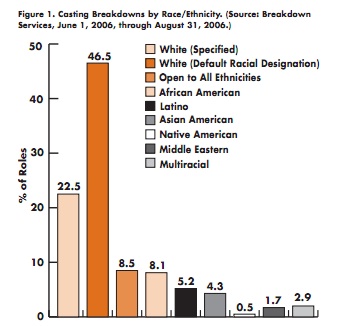
Today I'd like to talk a little bit about color-blind casting in both Broadway plays and Hollywood movies. This is an issue for both nonwhite actors and those who study and percieve racial inequalities in the United States (I'm going to stick to just the US, because there are other racial issues when moving to other countries). To begin to address this issue, the root starts at the scripts for movies and plays. This chart shows the breakdown of casting calls between June 1-August 31, 2006 for roles (not extras or stunt people):

Not only do the vast majority of specified roles go to white people, but almost half of all of the roles are unspecified roles that by default go to white people.

It's pretty easy to see the inequality here, but let's play a little devil's advocate and move to the other side of the issue. There are movies and plays that REQUIRE specific genders to increase the plot's meaning. Take a play/movie like Hairspray, for example. The plot hinges upon there being black and white characters. If Penny and Seaweed weren't a black man and white woman, would the song "Without Love" make any sense at all?

Let's look at some recent examples of mixed-race casting. One movie that recently came under fire was M. Night Shyamalan's The Last Airbender. This movie is based on the children's show Avatar: The Last Airbender, an animated show in which all of the main characters were Asian.

But in the live action movie version, most of the actors playing these characters were white. 

Shyamalan's response? He actually WAS practicing color blind casting: he chose which actors he thought best for the main roles, regardless of their race. He claimed that the anime style of the original series left the race of the main characters open for interpretation, and he took the artistic interpretation he was allowed as director. 

And sometimes, white actors are chosen to play non-white characters. Angelina Jolie, who usually looks like this:
Played Marlane Pearl, a French reporter with Afro-Cuban and Dutch heritage in the film A Mighty Heart. Jolie's skin and hair were darkened for the role, so that she more resembled Pearl.
But Jolie was selected by Pearl herself, believing that Jolie would provide the most integrity to the role.

So my question to you, readers, is:
Should color-blind casting always be practiced? Sometimes? Never? When is it appropriate?
Feel free to leave your thoughts on color-blind casting vs traditional, race-specified casting in the comments.

As always, thanks for reading!!
Meghana

Wednesday, October 26, 2011

Quick Quote

"I don’t wax my eyebrows to appease people making snap judgements about me, I do it because I choose porn-compliant eyebrows. Choosing makes me a feminist. If porn-compliance happens appease to people making snap judgements, well, that’s entirely accidental."

This quote is from a blog post on I Blame the Patriarchy, which I think sums up my feelings about feminism and my feelings about aesthetics. Choosing to wear makeup and care about fashion does not make me an antifeminist (although I may joke that it does). I wear what I wear and apply the makeup that I do because I enjoy it...not to appease someone else.

Along the same lines, I recently found out that my high school is considering abolishing the "Best Dressed" senior superlative. As a senior who very much cares about fashion, I am upset. They claim that this is an unfair superlative, because having a superior fashion sense means you spend more money on your clothes. I completely disagree, you could have an amazing fashion sense and spend very little on your clothes (I buy many of my clothes at Goodwill, Salvation Army, Plato's Closet, and assorted thrift shops). It's a little insulting to someone who cares about fashion and who dresses well because I enjoy it to hear it belittled to nothing more than a petty narcissistic industry and hobby.

That's just what's on my mind today, but I'd love to hear what anyone else thinks about the quote I found from the blog post or my thoughts on the "Best Dressed" superlative.

Until next time,
Meghana

Sunday, October 16, 2011

Transforming Yourself: Stage Makeup for Romeo and Juliet

This week I'd like to focus a little less on the academic side of this blog and a little more on the pure aesthetic side of the blog. This last week I had the amazing experience of doing the makeup for my school's production of Romeo and Juliet. For anyone reading this blog that does not go to my school, let me just add that our school affords us a lot of amazing experiences, and our theatre program is both well funded and very high quality.

For the next three weeks, I'd like to focus on the transformative aspect of aesthetics: how easy it is to transform your appearance and how that affects you. That is one of the things that I can take away from my experience with Romeo and Juliet: many of the cast members expressed how theatre can be an escape for them, that they become a complete other person and don't have to focus on themselves for a while. And my job is to make sure that they complete that transformation not only on the inside but on the outside so that the audience believes it.

Working behind the scenes on a play is amazingly enjoyable for me. It's hard to explain to the actors, whose greatest ambition is to be on the stage under a spotlight, but it is much more fulfilling to me to be the one waiting offstage with powder for when they sweat (ew, I know) or blush for when they get a little too washed out. In fact, as I found out last year, I really hate being on stage.

Being able to contribute to the success of a play like Romeo and Juliet, and to watch my friends and peers become fantastic actors was an absolutely rewarding and wonderful experience for me. And helping a 17 year old look like he's 50, well, that's both awesome and hilarious.

It's interesting to me how looking like another person can so wholly transform you. You can't completely become that other person until you walk in their shoes. One perfect example is my friend Megan, who played Lady Capulet. We gave her really sharp lines on her face and dark makeup, which only intensified her sternness as a character. She looked absolutely awesome and you could often catch her staring at herself in the mirror and scowling, because looking like Lady Capulet helped her become Lady Capulet.

In the next two posts, I want to explore other ways that people transform their outer shells to transform themselves on the inside, if only for one night.

Until next time,
Meghana

Sunday, October 9, 2011

Racism: Discrimination Based on Aesthetic Differences

One thing that interests me most about aesthetics is the human perception of aesthetic differences. What got me thinking about this is the book we are currently reading in my English class, The Poisonwood Bible by Barbra Kingsolver (if you need a quick summary, here is one). I find it interesting to hear the reactions of this white family from the South to native African culture and the differences they find between them and the Congolese.

It is funny to me to look back at the many justifications for racism, when in reality, it all comes down to discrimination based on aesthetic differences. It is interesting to note that racism is a fairly modern concept. Before there were people objecting to the morality of slavery, there was really no rationale for slavery other than its convenience. There began to be modern racism when people started to realize that slavery was a massive human rights abuse. It was then that they had to form some sort of rationale as to why slavery existed, and that was that people of color were inferior to whites.

There were many ideas of why blacks specifically were inferior to whites. In the book, the girls don't really understand why, other than that is what they always have known. The youngest girl, Ruth May, is interesting because she is used to talk about sensitive subjects since she is just a child regurgitating what she hears. She says that it's not the Congolese people's fault that they are doomed to this life without God's light, because they are the tribes of Ham and are doomed to be in servitude forever. This was a prominent rationale among white Southerners defending slavery. Using the Bible as evidence for the inherent inferiority of blacks was an easy way to say that whites were meant to be superior.

There were attempts to say that blacks were genetically inferior, that they were the middle ground between Caucasians and apes. There have even been attempts to show that based on different body measurements, blacks did not grow past puberty, and therefore it was the whites' job to take care of them.

All of these attempts at justification come back to the one issue, that a certain group of people were discriminated against based on something they can not control: the color of their skin. This shows how important aesthetics really are, by just looking a certain way it can affect your place in society. In further blogs, I'd like to explore a little bit more about the different types of aesthetic differences that can affect how you are percieved.

Until next time,
Meghana